
How to Choose the Right Breast Implant Size: A Surgeon's Guide
Learn how to choose the right breast implant size using base width, tissue and lifestyle, not just cc. Guidance from a Dubai and Bengaluru plastic surgeon.
Published 28 September 2026 · 9 min read
Key points
- Implant size is volume, base width and projection together, not a cup size or a single cc number.
- Base width should broadly match your breast base width; it sets the limit for a proportionate implant.
- Soft-tissue thickness, skin elasticity, frame and lifestyle all influence the size your tissue can carry.
- Sizer trials in a surgical bra turn measurements into a realistic visual impression.
- Your final size becomes clear around three to six months, once swelling settles.
- Weight stability and future pregnancy plans should be discussed before size is finalised.
In this article
- Breast Implant Size Explained: Volume, Base Width and Projection
- Who Is a Good Candidate for a Larger or Smaller Breast Implant Size
- How Breast Implant Size Is Chosen Step by Step
- Risks of Choosing the Wrong Breast Implant Size
- Breast Augmentation Recovery Timeline and When the Final Size Appears
- Breast Implant Cost in Dubai and Bengaluru
- Breast Implant Sizing for Indian Expats and NRI Patients
Breast implant size is the combination of volume (measured in cubic centimetres, or cc), base width and projection that together determine how an implant sits on your chest — and it is chosen by matching the implant to your own tissue measurements rather than to a target cup size. It is relevant to anyone considering breast augmentation, and equally to those planning an implant exchange.
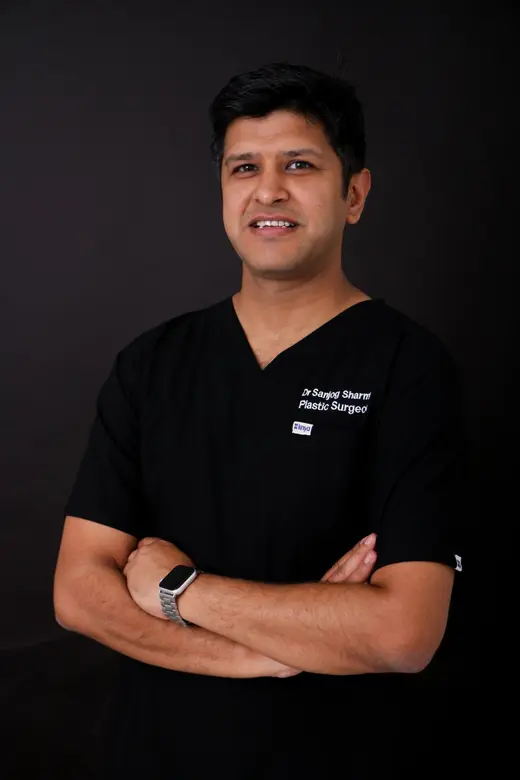
Last medically reviewed by Dr. Sanjog Sharma, MBBS MS DNB — 28 September 2026
Breast Implant Size Explained: Volume, Base Width and Projection
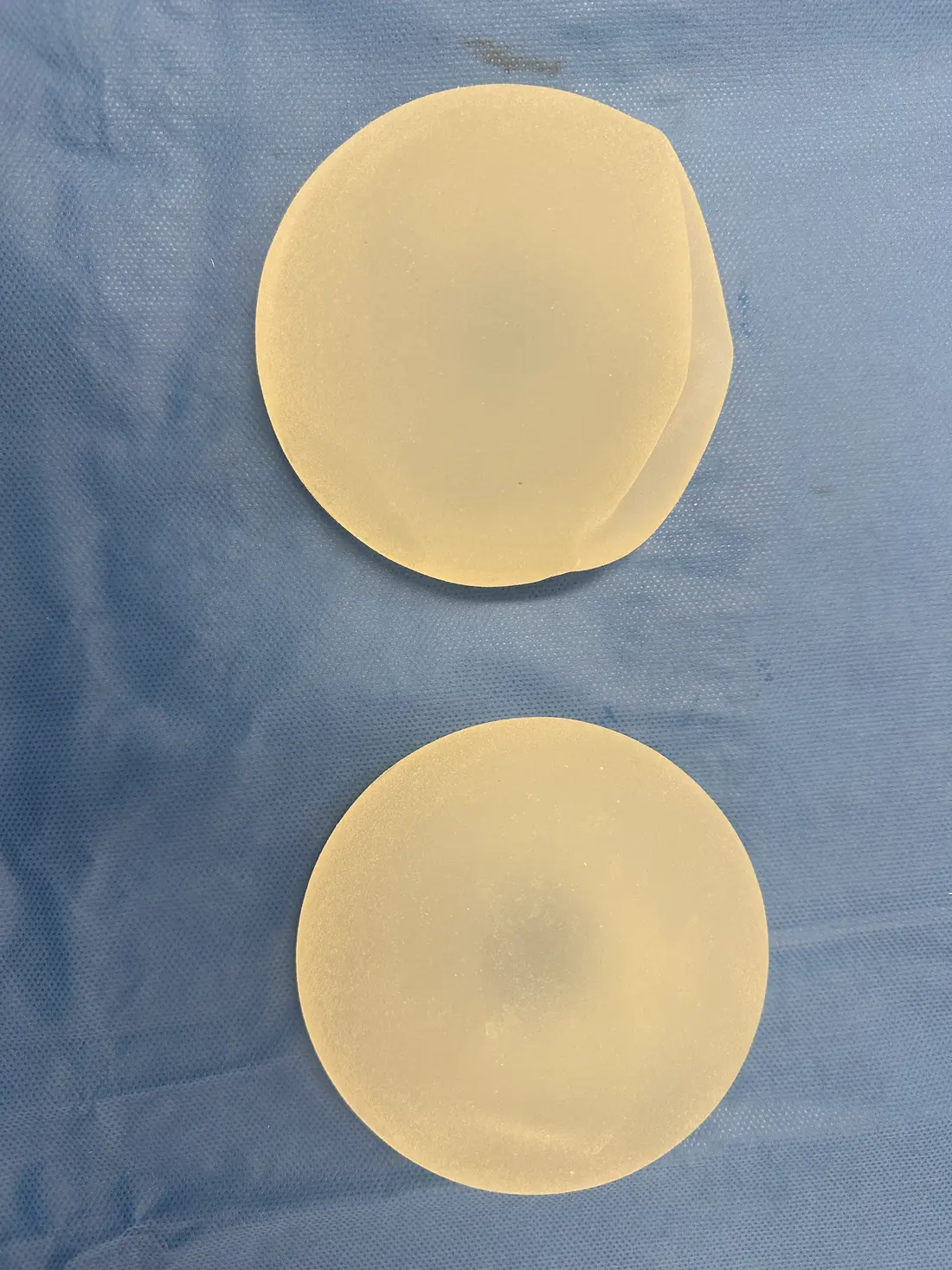
Most people begin with a number: a cup size, or a cc figure they have heard from a friend. Neither describes what the implant will actually do on your body. Three dimensions matter together. Volume is how much the implant holds, in cc. Base width is the diameter of the implant where it rests on the chest wall, in centimetres. Projection (profile) is how far the implant stands forward from the chest.1
Two implants with the same volume can look very different. A moderate-profile implant is wider and projects less, while a high-profile implant is narrower and projects more. On a narrow chest, a wide implant can spill toward the underarm; on a broad chest, a narrow implant can look pushed together in the centre. This is why volume alone is a poor guide.
Cup size is unreliable for a second reason: it is a bra measurement, not a medical one. Brands, countries and even styles within one brand label cups differently. As a rough rule of thumb, around 150 to 200 cc of volume corresponds to one cup size, but the range is wide, and the same volume reads differently depending on your height, chest width and starting breast tissue.2 I therefore treat cc as one variable among several, never as the goal.
In my practice at Cocoona Centre for Aesthetic Transformation in Dubai, the most common sizing conversation starts with a photograph and a cup size. I usually ask patients to set the number aside and describe the look they want: subtle, proportionate, or clearly fuller. The measurements then tell us which of those looks their anatomy can carry safely.
Who Is a Good Candidate for a Larger or Smaller Breast Implant Size
There is no single correct size, only a range that fits your tissue and your priorities. A larger implant needs enough soft-tissue coverage and skin elasticity to support it, and a wider chest wall to sit on. A smaller or moderate implant is often more forgiving, particularly where the tissue is thin or the frame is narrow. Personal factors matter too: work, sport, and whether you plan pregnancy or major weight change.
| Factor | Points toward a smaller or moderate implant | Points toward a larger implant |
|---|---|---|
| Chest and breast base width | Narrow | Broad |
| Soft-tissue thickness at the upper breast | Thin (little pinch thickness) | Thicker, with good coverage |
| Skin elasticity | Limited, or previous stretching | Good, firm skin |
| Body frame and height | Petite frame | Taller or broader frame |
| Lifestyle | Frequent running or gym training | Less high-impact activity |
| Future plans | Pregnancy or weight change expected | Weight stable, family complete |
| Goal | Subtle, proportionate change | Clearly fuller shape |
This table is a guide for discussion, not a rule. Most patients fall between the columns, and the final choice is a trade-off that I make with each patient in consultation. Candidacy also depends on general health, the absence of active infection, and realistic expectations about what an implant can and cannot change. Breast augmentation is often planned alongside other procedures; for patients also considering abdominal surgery, our overview of body contouring explains how these operations are combined and staged.
How Breast Implant Size Is Chosen Step by Step
A tissue-based approach starts from your measurements and works outward to volume, rather than picking a volume first and hoping the tissue accommodates it. The published decision-support process by Tebbetts and Adams built on this idea, reducing sizing to a small set of measurements that drive the main choices.1 The sequence below reflects the same logic.
- Define the goal. You describe the result you want, ideally with reference photographs. I ask you to point out what you like and what you would not want, since words like natural and full mean different things to different people.
- Measure the chest and breast. I measure the width of the breast base, the thickness of the soft tissue with a pinch test, the distance from the nipple to the fold under the breast when the skin is gently stretched, and how much the skin stretches. Chest wall shape and any existing asymmetry are noted as well.
- Set the base width limit. The implant base width should broadly match the width of your own breast base. This step sets the upper limit of implant size that will look proportionate; going beyond it is where problems tend to begin.
- Choose volume and profile within that width. With width fixed, volume and projection are adjusted to match your tissue coverage and how full you want to look.
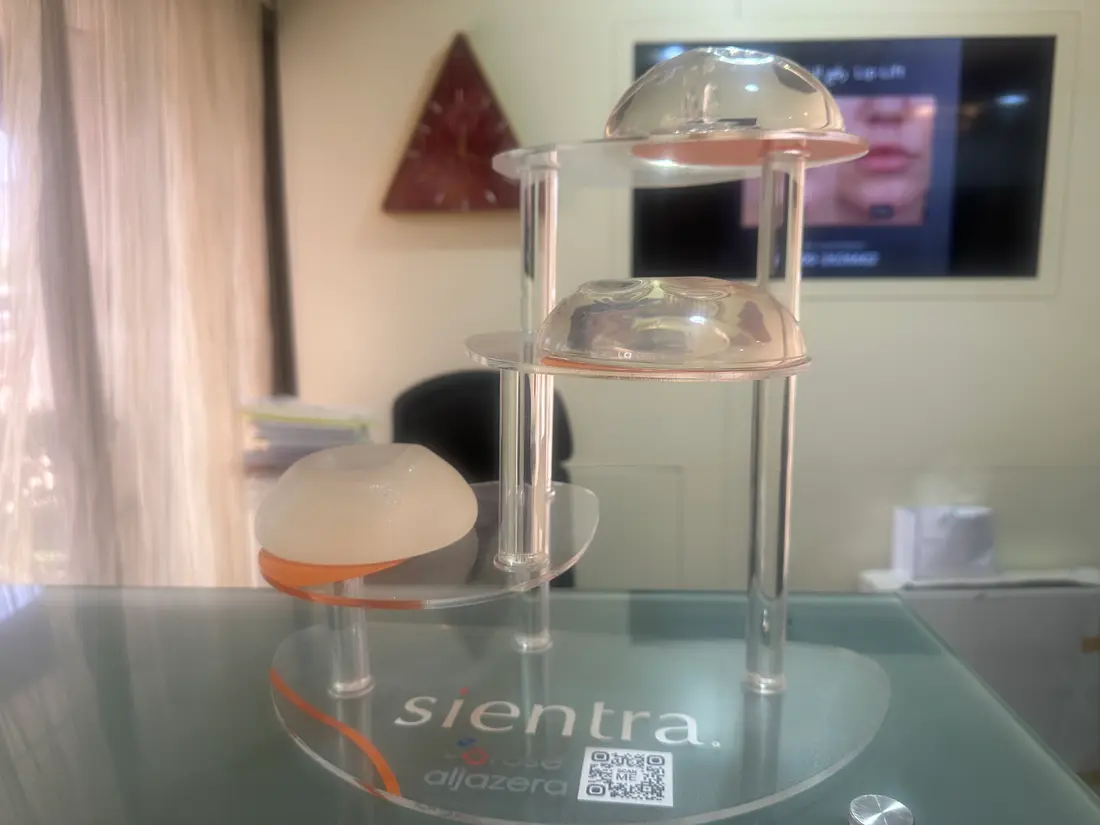
- Trial with sizers. You try sizers, which are implant-shaped devices worn inside a surgical bra, and view yourself in clothes you would normally wear. Simple in-clinic tools, or 3D simulation where available, can help you visualise options. These simulations are approximations of shape, not a prediction of the final result.
- Confirm implant and pocket. We agree the final implant and decide where it sits: beneath the breast tissue or beneath the pectoral muscle. Thin tissue often favours the muscle plane for additional coverage.
Implant Profile and Shape
Profile changes the look without changing volume much. Moderate profiles suit broader chests and a natural slope. Higher profiles suit narrower chests where projection is needed without exceeding the width limit. Round implants give more fullness at the upper breast, while anatomical (teardrop) implants follow a more gradual slope but depend on staying correctly oriented.3
Silicone and Saline Implants
Silicone gel implants are more commonly used in my practice because they feel closer to natural tissue and show less visible rippling in thinner patients. Saline implants are filled during surgery, which allows small volume adjustment, but they can ripple more visibly. Both are approved by regulators such as the US Food and Drug Administration (FDA), and the choice does not change the width-first sizing logic.
At Dubai London Hospital, the consultation protocol I follow keeps this sequence deliberately slow. Patients often arrive ready to decide on volume, and I would rather spend time on measurements and sizers, since that is where most sizing mistakes can be prevented. I also document the plan and the agreed implant dimensions so that it is clear later what was chosen and why.
Risks of Choosing the Wrong Breast Implant Size
Size choice affects the safety profile of the operation, not only its appearance. Where an implant is too large for the tissue, the breast has to carry more weight, and the following problems become more likely. These are recognised concerns discussed in the surgical literature:3,4
- Tissue thinning and stretching. Excess weight can thin the overlying tissue over time.
- Visible edges and rippling. Thin coverage lets the implant edge or surface irregularity show, particularly at the upper breast and the cleavage.
- Bottoming out and displacement. The implant can descend below the fold, or move sideways if the pocket is over-dissected.
- Asymmetry. A single implant size for two different breast bases can leave a visible difference.
- Revision surgery. Long-term core studies of silicone implants report that a meaningful share of patients, in the range of roughly one in five over ten years, undergo a further operation; size dissatisfaction is one of several documented reasons.4
An implant that is too small carries its own downside: a result that feels underwhelming, and a request for a larger exchange later. It is why I discuss both directions openly. Other general risks of breast augmentation, including infection, bleeding, changes in nipple sensation and capsular contracture, are independent of size but should be discussed at consultation; you can read more in our article on capsular contracture and how it is managed. Reputable bodies such as the International Society of Aesthetic Plastic Surgery (ISAPS) and the FDA also recommend regular follow-up and imaging as advised for the type of implant.
Weight is a special consideration. Patients using GLP-1 medication such as Ozempic or Wegovy, or planning significant weight loss, should tell their surgeon early. Losing weight after implantation changes breast volume and can make a previously proportionate implant look larger or more visible, so I usually prefer that weight is stable before finalising size.
Breast Augmentation Recovery Timeline and When the Final Size Appears
The size you see on the first day is not the size you will live with. Swelling makes the breasts look larger and firmer, and the implants sit high on the chest until the surrounding tissue relaxes. This settling phase, sometimes called drop and fluff, is one reason to avoid judging size in the first weeks.
| Time after surgery | What to expect |
|---|---|
| First week | Swelling, tightness and tenderness; light walking encouraged; most people rest at home |
| Weeks 2 to 4 | Return to desk work usually possible; avoid heavy lifting and strenuous exercise |
| Weeks 4 to 6 | Gradual return to gym activity as advised; supportive bra continues |
| Months 3 to 6 | Implants settle into position; shape and size become clearer |
| Months 6 to 12 | Final softness and minor changes continue to develop |
Recovery varies between patients and depends on the plane of placement, the extent of surgery and individual healing. For a fuller week-by-week account, see our article on breast augmentation recovery.
Breast Implant Cost in Dubai and Bengaluru
Cost depends on the implant type and brand, the hospital or clinic, the anaesthesia and the surgeon's fee. As general indicative ranges, breast augmentation with implants typically falls between about AED 25,000 and AED 45,000 in Dubai, and between about INR 3,00,000 and INR 6,00,000 in Bengaluru. These ranges are estimates, may not include follow-up or revision, and change over time. An accurate figure needs an in-person consultation where size, implant type and the surgical plan are confirmed.
Breast Implant Sizing for Indian Expats and NRI Patients
A significant proportion of my Bengaluru patients are Indian expats returning from the UAE, the UK or Australia, and they plan surgery around a limited stay. That makes sizing decisions harder, because it is difficult to adjust later. I encourage a preliminary video consultation and measurements shared in advance, then a full in-person assessment on arrival, with sizer trials done before the surgery date is fixed. I operate at Aesthetica Veda Clinic, Whitefield, Bengaluru, and at Cocoona Centre for Aesthetic Transformation, Dubai, so follow-up can be arranged in either place.
Body frame matters too. Many South Asian patients have a narrower chest wall and a shorter torso, which lowers the base width that can be accommodated and often favours moderate implant volumes chosen for proportion. Skin type also matters, since Fitzpatrick III to VI skin has a higher tendency for pigmentation changes and thick scarring, which is discussed during planning. I am trained as a plastic surgeon (MBBS, MS, DNB), and this frame-and-skin-specific planning is part of every breast consultation.
Questions patients ask
How do I choose the right breast implant size?
The right implant size is matched to your chest wall width and soft-tissue thickness, not to a target cup size. Your surgeon measures base width, tissue coverage and skin elasticity, then you try sizers in a surgical bra. This tissue-based approach reduces the chance of visible edges, tissue stretching and revision surgery.
How many cc is one cup size?
Roughly 150 to 200 cc of implant volume corresponds to one cup size, but this varies widely between patients. Bra brands differ, and the same volume looks different on a narrow chest than on a broad one. Surgeons therefore plan by base width and tissue, and treat cc as one variable rather than a target.
Does a bigger breast implant look more natural?
A bigger implant does not necessarily look more natural, because natural results depend on proportion to your chest width and tissue coverage. Implants that exceed what your tissue can cover often show visible edges and upper-pole fullness, and they place more long-term load on the breast tissue.
Can I change my breast implant size later?
Yes, implant size can be changed with a revision operation, but it means a second surgery with its own cost and recovery. Size dissatisfaction is a recognised reason for revision, which is why careful planning, sizer trials and realistic expectations before the first operation matter. Weight change or pregnancy can also alter how an implant looks.
How does weight loss or GLP-1 medication affect implant size?
Significant weight change alters breast tissue and can make a previously well-fitting implant look larger, more visible or lower on the chest. If you use or plan to use GLP-1 medication such as Ozempic or Wegovy, tell your surgeon, because stabilising weight before choosing implant size often leads to a more predictable fit.
How long until I see my final breast implant size?
Your final implant size and shape usually become clear around three to six months after surgery, once swelling settles and the implants drop into position. Early on, implants sit high and look firmer and larger. Subtle changes can continue up to twelve months, so judging size in the first weeks is unreliable.
References
- Tebbetts JB, Adams WP. Five critical decisions in breast augmentation using five measurements in 5 minutes: the high five decision support process. Plast Reconstr Surg. 2005;116(7):2005–16. pubmed.ncbi.nlm.nih.gov/16327616/
- Hidalgo DA, Spector JA. Breast augmentation. Plast Reconstr Surg. 2014;133(4):567e–583e. doi.org/10.1097/PRS.0000000000000033
- Coombs DM, Grover R, Prassinos A, Gurunluoglu R. Breast augmentation surgery: Clinical considerations. Cleve Clin J Med. 2019;86(2):111–122. doi.org/10.3949/ccjm.86a.18017
- Spear SL, Murphy DK. Natrelle round silicone breast implants: Core Study results at 10 years. Plast Reconstr Surg. 2014;133(6):1354–1361. doi.org/10.1097/PRS.0000000000000021
MBBS, MS (General Surgery), DNB (Plastic Surgery) · KMC DLH 2020 0000540 KTK · DHA 24430721
This article is general information for patients and does not replace a consultation. Costs mentioned were indicative when it was written — current Bangalore and Dubai ranges are on each procedure page. All surgery carries risk, and results vary between individuals.
A question about your own case? Send it with photos — Dr Sanjog replies personally.
WhatsApp