Tummy tuck in Bangalore
Most people who come to see me about a tummy tuck have already done the hard work. They've lost the weight, committed to exercise, given their body time after pregnancy — and still the lower abdomen doesn't reflect that effort. The loose skin stays, and the muscle separation doesn't close on its own. That gap is what a tummy tuck is for.
Quick summary
- A tummy tuck removes excess skin and fat from the abdomen and, in most cases, repairs separated abdominal muscles (diastasis recti).
- It reshapes; it is not a weight-loss operation. Ideally it is planned once your family is complete and your weight is stable.
- A full abdominoplasty takes 2.5–4 hours under general anaesthesia; a mini tummy tuck about 1.5–2 hours.
- Most patients return to desk work in 2–3 weeks; strenuous exercise waits 6–8 weeks; the final result shows at 6–12 months.
- Cost starts from ₹2,30,000 in Bangalore and from about AED 35,000 in Dubai, depending on how much skin is removed and whether the muscles are repaired.
At a glance
- Anaesthesia
- General
- Operating time
- 2.5–4 h full · 1.5–2 h mini
- Drains
- Usually 5–7 days
- Compression garment
- 4–6 weeks
- Back to desk work
- 2–3 weeks
- Strenuous exercise
- After 6–8 weeks
- Final result
- 6–12 months
- Bangalore
- From ₹2,30,000
- Dubai
- From AED 35,000
Indicative. Your plan and quote are confirmed after consultation; results and recovery vary.
Is it right for you?
Good candidates are adults at a stable, healthy weight who carry excess abdominal skin or weakened core muscles that haven't responded to diet and exercise. Three groups come most often:
- After pregnancy — particularly after more than one — when the abdominal wall has stretched beyond what it can recover.
- After significant weight loss, whether through lifestyle change, bariatric surgery or GLP-1 medicines such as Ozempic or Mounjaro.
- Anyone with loose lower-abdominal skin or muscle separation that exercise hasn't changed.
When to wait
- More pregnancies planned? Wait — a later pregnancy stretches the repaired muscles again.
- Weight still changing? Wait until it has been stable for several months; the result lasts better.
- Smoking must stop well before surgery. Clotting history and previous abdominal operations are reviewed at consultation.
Mini, full or extended
Above and below the navel
For skin laxity across the whole abdomen, or moderate-to-severe muscle separation. The navel is repositioned and the muscles are repaired.
Lower abdomen only
For a lower "pouch" in people close to their ideal weight. A shorter scar, no change to the navel, and a faster recovery.
Extended or belt lipectomy
When loose skin wraps round to the flanks or back, the incision extends further; circumferential excess may need a belt lipectomy.
With liposuction
Selective liposuction of the flanks can be combined. Aggressive liposuction of the lifted abdominal skin is avoided — it risks wound problems.
On the day
A tummy tuck is performed under general anaesthesia. For a full abdominoplasty the incision runs low across the abdomen, placed to sit within the natural bikini line. Through it, the separated muscles are repaired where diastasis is present — as it almost always is after pregnancy — the excess skin and fat are removed, and the navel is brought out in its new position.
Drains are usually placed for the first 5–7 days to prevent fluid collecting, and a compression garment is worn for 4–6 weeks. Whether you go home the same day or stay overnight is agreed at consultation.
Recovery, step by step
- Days 1–7
Rest at home with drains in place. The abdomen feels tight — normal, and it eases as swelling settles. Light walking from day two helps circulation.
- Week 2
Drains are removed in most cases. Bruising fades and you feel noticeably more comfortable, but avoid anything that engages the core.
- Weeks 2–4
Most people return to desk work around the two-week mark. No driving until you're off strong painkillers.
- Weeks 4–8
The compression garment continues. Normal activity returns gradually — no gym, heavy lifting or core exercise yet.
- Week 8 onwards
Strenuous exercise can resume and most swelling has gone. The scar keeps fading and softening over the following months.
The final result — including a matured scar — is usually seen between 6 and 12 months.
Results
A flatter, firmer abdomen, and — where the muscles were repaired — a stronger core and better posture. The result lasts as long as your weight stays stable; a later pregnancy or significant weight gain can undo part of it.
There is always a scar: a horizontal line low across the abdomen, designed to sit inside underwear or swimwear, plus one around the navel after a full abdominoplasty. It fades over 12–18 months but does not disappear. Results vary between individuals.
Risks & safety
The most common complication is a seroma — fluid collecting under the skin — which is drained and usually settles without lasting effect. Numbness of the lower abdominal skin is common and improves over months.
Other risks: infection, delayed wound healing (much more likely in smokers), bleeding, fat necrosis, asymmetry or "dog-ears" at the scar ends, and a thick or dark scar — South Asian skin carries a higher risk of hypertrophic scarring, which is planned for.
Serious but uncommon: blood clots in the legs or lungs (DVT or pulmonary embolism) — higher after major weight loss — and reactions to anaesthesia. Early walking, compression and clot prevention reduce these risks; your personal risk is assessed before surgery.
Cost in Bangalore & Dubai
A mini tummy tuck, a full abdominoplasty and surgery after major weight loss differ in how much skin comes out and how long theatre takes, so each is quoted after assessment.
For surgery at Cocoona Clinic or Dubai London Hospital. Your quote is confirmed at consultation; 5% VAT applies in the UAE.
What moves the number
- Mini, full or extended — how much skin is removed.
- Muscle repair for diastasis.
- Liposuction of the flanks, if combined.
- Facility and anaesthesia time, and whether you stay overnight.
Price should never be the reason to choose a surgeon — a much cheaper quote usually means the facility, the anaesthesia standard or the surgeon's training is being compromised.
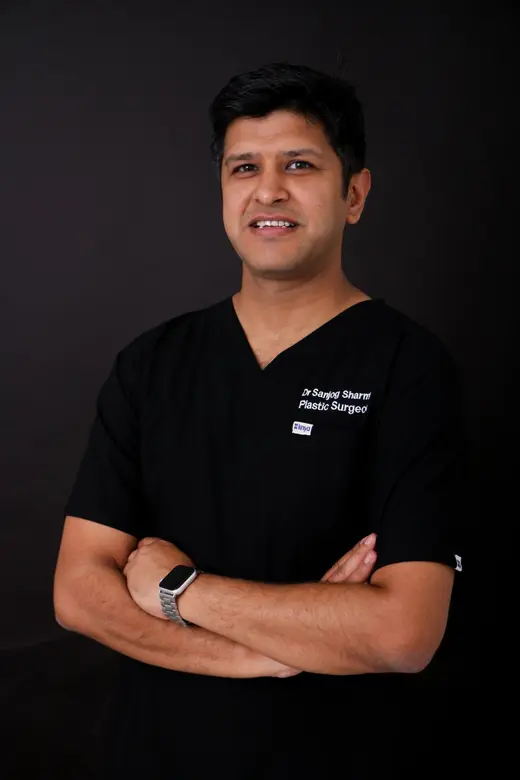
Why patients choose Dr Sanjog
- The surgeon you meet is the surgeon who operates.
- Honest timing advice — including when to wait for your family to be complete or your weight to settle.
- Experience with the post-pregnancy and post-weight-loss abdomen, where muscle repair and skin quality decide the result.
- Scar planning for South Asian skin, which heals differently.
- Two cities. Surgery in Bangalore at Aesthetica Veda, or in Dubai at Cocoona Clinic and Dubai London Hospital.
MBBS, MS (General Surgery), DNB (Plastic Surgery) · KMC DLH 2020 0000540 KTK · DHA 24430721
Questions patients ask
How much does a tummy tuck cost in Bangalore?
With Dr Sanjog in Bangalore, a tummy tuck starts from ₹2,30,000. What you pay depends on whether it is a mini or a full abdominoplasty, whether the separated muscles are repaired, how much skin is removed — more after major weight loss — and the facility. The figure is confirmed at consultation.
How much does a tummy tuck cost in Dubai?
In Dubai, a tummy tuck with Dr Sanjog starts from about AED 35,000, depending on the extent of surgery, muscle repair and the facility. Your exact quote follows consultation, and 5% VAT applies in the UAE.
What's the difference between a mini and a full tummy tuck?
A mini tummy tuck treats only the lower abdomen below the navel, with a shorter scar and no change to the navel. A full abdominoplasty treats the whole abdomen, repositions the navel and usually repairs separated muscles. Which you need depends on where the loose skin is and whether the muscles have separated.
How long is tummy tuck recovery?
Most patients return to desk work and light activity within two to three weeks of a full abdominoplasty. Strenuous exercise, heavy lifting and core work wait for at least six to eight weeks. Swelling keeps reducing for months, and the final result, including the matured scar, shows at six to twelve months.
Is a tummy tuck safe?
It is a well-established operation, but it carries real risks. The most common is a seroma, a fluid collection that is drained. Others include infection, delayed healing — especially in smokers — and blood clots, which are more likely after major weight loss. Your personal risk is assessed and reduced before surgery.
Can I get pregnant after a tummy tuck?
Pregnancy after a tummy tuck is not unsafe, but it stretches the repaired muscles and skin again and is likely to undo part of the result. That's why the operation is ideally planned once your family is complete. If you plan more pregnancies, it's usually worth waiting.
Will I have a visible scar?
Yes. A tummy tuck leaves a horizontal scar low across the abdomen, placed to sit within underwear or swimwear, and a scar around the navel after a full abdominoplasty. It fades over 12–18 months but never disappears. South Asian skin has a higher risk of thick scarring, which is planned for.
How soon after weight loss can I have a tummy tuck?
Wait until your weight has been stable for at least three to six months, including after Ozempic, Mounjaro or bariatric surgery. Nutrition, especially protein, should also be optimised first. Operating while weight is still changing gives a poorer, less lasting result and a higher risk of wound problems.
Does a tummy tuck repair separated muscles?
Yes. When the abdominal muscles have separated — diastasis recti, which is common after pregnancy and major weight loss — they are stitched back together during a full abdominoplasty. This improves the shape of the abdomen and often core strength, in a way exercise alone cannot.
Related
This page explains the procedure in general terms. It is not a substitute for an in-person consultation. All surgery carries risk, and results vary between individuals.
Find out which tummy tuck you need.
Send photos of your abdomen from the front and side, and a note on your pregnancies and weight history. Dr Sanjog will tell you honestly whether you need a mini, full or extended procedure — or none yet.