
Loose Skin After Mounjaro: What Helps, What Doesn't, and When Surgery Makes Sense
Lost weight on Mounjaro and left with loose skin? A Bengaluru plastic surgeon explains what tightens on its own, when surgery helps, timing, risks and cost.
Key points
- Loose skin after Mounjaro comes from fast, large weight loss: in SURMOUNT-1, the 15 mg dose averaged 20.9% over 72 weeks.
- Some laxity settles in 6 to 12 months, but folds of skin rarely resolve with exercise, creams or devices.
- Liposuction alone usually makes loose skin look worse; excess skin needs excision.
- Surgery is planned once weight has been stable for 3 to 6 months and nutrition has recovered.
- Never stop Mounjaro on your own before surgery; your prescribing doctor and anaesthetist decide.
- Risks are real, scars are long, and recovery and results vary between individuals.
In this article
- Why does Mounjaro cause loose skin?
- Where does loose skin appear after Mounjaro weight loss?
- Will loose skin after Mounjaro tighten on its own?
- Am I a candidate for surgery for loose skin after Mounjaro?
- Should I stop Mounjaro before surgery?
- How is body contouring after Mounjaro performed?
- What are the risks of surgery for loose skin after weight loss?
- What is the recovery timeline after surgery for loose skin?
- How much does surgery for loose skin after Mounjaro cost in Bengaluru?
- Planning surgery in Bengaluru if you live abroad
Loose skin after Mounjaro is the excess, inelastic skin left behind when tirzepatide (Mounjaro) produces large, fast weight loss: the fat underneath shrinks, but the skin that stretched around it does not fully contract. It mostly affects people who have lost 15 kg or more, and it shows up on the abdomen, upper arms, inner thighs, breasts and chest.
Over the past year the conversation in my consultation room has changed. Patients used to come in having lost weight over five or ten years. Now many arrive eighteen months after their first Mounjaro injection, 20 or 25 kg lighter, and the first thing they say is some version of: "I did everything right, so why does my stomach look like this?"
The answer is not that anything went wrong. It is what happens to skin when weight comes off quickly. This article explains why it happens with Mounjaro in particular, what improves on its own and what does not, when surgery makes sense, and how I plan it for patients at Aesthetica Veda Clinic, Whitefield, Bengaluru, the practice I co-founded. It is not advice on starting, continuing or stopping any medicine; that conversation belongs with the doctor who prescribes it.
Why does Mounjaro cause loose skin?
Mounjaro causes loose skin mainly because it causes a lot of weight loss, quickly, and skin cannot shrink as fast as fat does.
Tirzepatide works on two gut hormone receptors (GIP and GLP-1), which reduces appetite and slows how fast the stomach empties. In the SURMOUNT-1 trial, people with obesity taking the 15 mg weekly dose lost an average of 20.9% of their body weight over 72 weeks, and 57% of them lost a fifth of their body weight or more.1 In SURMOUNT-5, the first head-to-head trial, tirzepatide produced an average 20.2% loss against 13.7% with semaglutide, the drug in Ozempic and Wegovy.2
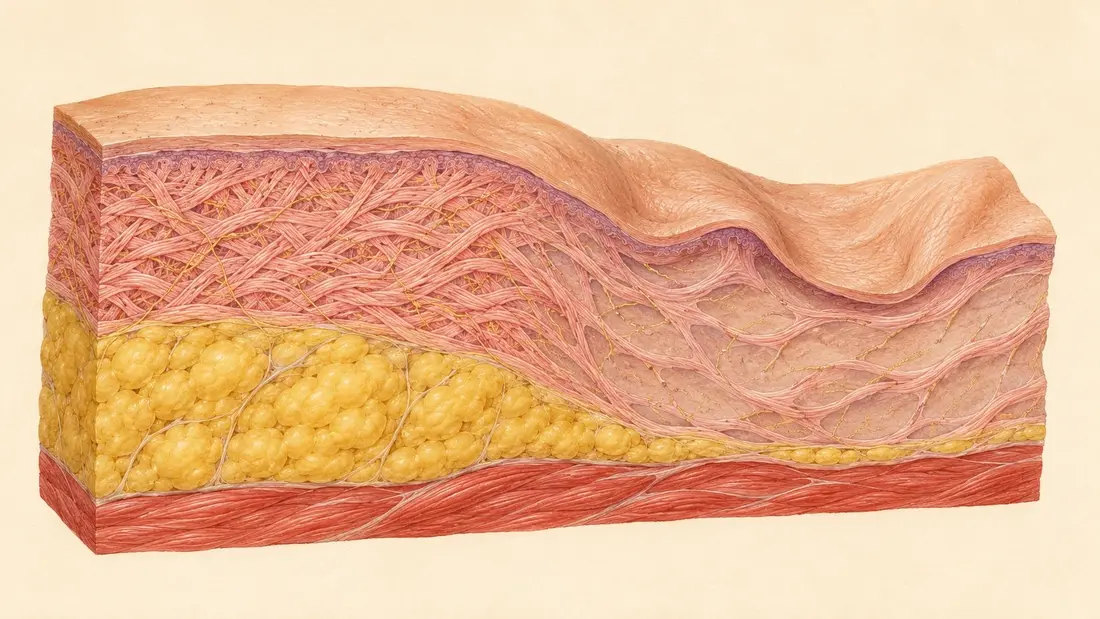
For a person who starts at 100 kg, that is 20 kg in roughly a year and a half. Skin is held in shape by a mesh of collagen and elastin. When it has been stretched for years and the volume under it then disappears over months, that mesh simply cannot recoil fully. The result is skin that folds, hangs or creases, most visibly where fat was stored the longest.
There is a second factor. A body-composition substudy of SURMOUNT-1, using DXA scans, found that about 75% of the weight lost on tirzepatide was fat and about 25% was lean mass, which includes muscle.3 That proportion was similar to placebo, so it is the weight loss itself rather than the drug that drives it. But it matters to me as a surgeon: a patient who has lost muscle along with fat often has less shape under the skin, and the loose skin looks more pronounced as a result.
If you have read my earlier article on body contouring after Ozempic and GLP-1 weight loss, the principles are the same. What I see with Mounjaro is the same picture, with somewhat more weight lost on average.
Where does loose skin appear after Mounjaro weight loss?
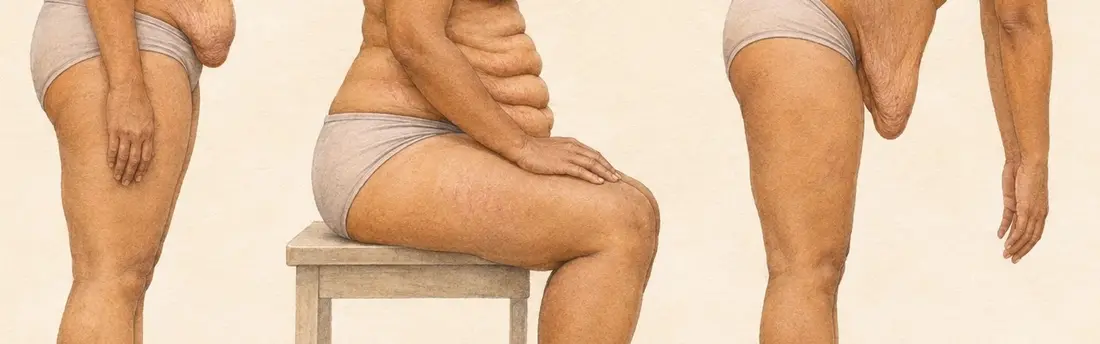
The abdomen is where most patients notice loose skin first, followed by the upper arms, inner thighs, breasts or chest, and in larger losses the back and buttocks.
In my practice, the pattern follows where each person stored fat before treatment. Women commonly describe a lower abdominal fold and deflated breasts. Men more often notice loose chest skin that looks like gynecomastia, and a fold above the pubic area. In Indian patients I also see a lot of upper-arm laxity, partly because many of my patients carried more weight centrally and in the arms to begin with.
| Area | What you may notice | Procedure usually discussed |
|---|---|---|
| Abdomen | A hanging lower fold, crepey skin, a weak or bulging tummy wall | Tummy tuck (abdominoplasty), sometimes a belt lipectomy |
| Upper arms | Skin that swings below the arm, sleeves fitting badly | Arm lift (brachioplasty) |
| Inner thighs | Folds, chafing and rashes when walking | Thigh lift |
| Breasts | Volume loss and sagging | Breast lift, with or without an implant |
| Male chest | Loose, sagging chest skin | Chest skin excision, sometimes with gland removal |
| Small fat pockets | Residual fat in flanks or back with good skin | Liposuction |
Will loose skin after Mounjaro tighten on its own?
Some loose skin improves over the first 6 to 12 months after your weight settles, but skin that hangs in folds rarely tightens enough on its own to disappear.
How much it recovers depends on things you cannot fully control: your age, how much weight you lost, how long you carried it, your genetics, sun exposure, smoking and previous pregnancies. A 28-year-old who lost 12 kg may find the skin settles well. A 50-year-old who lost 30 kg usually will not.
Strength training helps because rebuilding muscle fills out the space under the skin and improves the shape. Good protein intake helps for the same reason. Creams do not remove excess skin. Radiofrequency and ultrasound skin-tightening devices can give a modest improvement where laxity is mild, but they cannot remove a fold of skin.
The point I make to every patient is that liposuction alone is usually the wrong tool here. Removing more fat from under skin that is already loose can make the folds look worse. Liposuction has a role for small fat pockets where the skin is still firm, which is why I always assess skin quality before talking about any procedure.
Am I a candidate for surgery for loose skin after Mounjaro?
You may be a candidate if your weight has been stable for at least 3 to 6 months, you are in good general health, your nutrition has recovered, and the loose skin bothers you physically or emotionally.
I grade loose skin area by area, and the Pittsburgh Rating Scale, a validated system for grading contour changes after major weight loss, is a useful framework for that.5 These are the factors I look at before suggesting surgery:
| Factor | What I look for | Why it matters |
|---|---|---|
| Weight stability | Stable within about 2 to 3 kg for at least 3 to 6 months | Further loss or regain changes the result after surgery |
| BMI | Ideally below about 32 | Higher BMI is linked with more wound complications |
| Nutrition | Normal protein, haemoglobin, iron, vitamin D and B12 | Healing long incisions needs adequate building blocks |
| Diabetes | Good control (HbA1c), if you have diabetes | Poor control raises infection and wound risks |
| Smoking | Stopped, ideally for at least 4 to 6 weeks either side of surgery | Smoking reduces blood flow to the skin edges |
| Expectations | Understanding that surgery trades loose skin for scars | A good outcome depends on accepting that trade |
Nutrition deserves its own mention. Mounjaro suppresses appetite, and some patients have eaten very little protein for a year or more. In a study of patients who had body contouring after bariatric surgery, 38% had low prealbumin (a marker of protein status) and a third had low haemoglobin before their operation.6 That study was in post-bariatric patients, not people on Mounjaro, but the reasoning carries over, so I check these blood tests in every patient who has lost weight on medication.
Should I stop Mounjaro before surgery?
Do not stop Mounjaro on your own before surgery. Whether and when to pause it is decided by your prescribing doctor and your anaesthetist, based on your situation.
There are two separate questions here. The first is anaesthetic safety. Because Mounjaro slows how fast the stomach empties, there is a concern that food could still be in the stomach under anaesthesia and be inhaled. A 2024 multisociety guidance statement, from the American Society of Anesthesiologists and four surgical and gastroenterology societies, advises that most patients can continue these medicines before surgery, with the decision individualised. For patients at higher risk, such as those still increasing the dose or having nausea, it suggests measures like a liquid-only diet the day before or pausing a dose.4 Your anaesthetist applies this to you.
The second question is weight. Many people regain some weight after stopping these medicines, which is why I prefer to know where your weight is going to settle before I plan surgery. If you intend to continue on a maintenance dose, I want to see your weight stable on that dose. If you intend to stop, I want to see it stable after stopping. Operating while weight is still moving is one of the most common reasons results disappoint.
How is body contouring after Mounjaro performed?
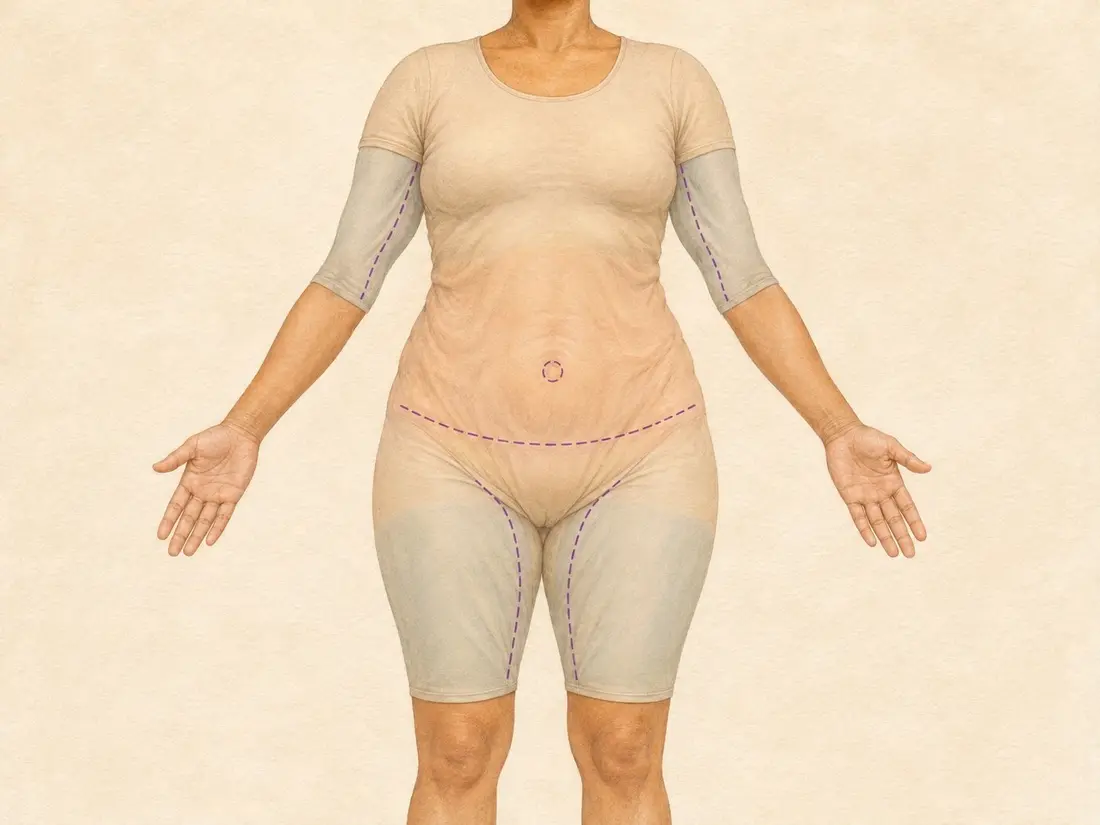
Surgery removes the excess skin through planned incisions, tightens the tissues underneath, and is often combined with liposuction for leftover fat pockets. It is done under general anaesthesia in an accredited hospital.
The detailed plan differs for every patient, but the sequence is consistent:
- Consultation and examination. I examine you in person, take standardised photographs, assess skin quality and the abdominal wall, and order blood tests. Every patient is examined in person before surgery.
- Planning and staging. We decide which areas matter most to you and whether they can be combined safely in one operation, or are better done in two stages several months apart. Combining a tummy tuck with a breast procedure is common; adding arms and thighs as well usually means staging.
- Marking. On the day of surgery I mark the incisions with you standing, because loose skin sits differently when you lie down.
- Surgery. Under general anaesthesia, the excess skin and fat are removed, the underlying tissues are tightened (including repair of separated abdominal muscles where needed), and the skin is closed in layers. Liposuction may be added to refine the edges.
- Early recovery in hospital. Drains may be placed, compression garments are fitted, and you are encouraged to walk within hours, with measures to reduce the risk of blood clots.
- Follow-up. Wound checks, drain removal and scar care continue over the following weeks. When I am in Dubai, Dr Vybhav Deraje, the resident plastic surgeon at Aesthetica Veda, sees you under a written handover arrangement. This is explained before surgery and set out on our page on how cross-border surgical care works.
You can read more about each operation on the body contouring after weight loss page.
What are the risks of surgery for loose skin after weight loss?
These are major operations with real risks, and the most common problems after weight-loss body contouring are fluid collection (seroma) and wound healing problems.
The risks I discuss with every patient include:
- Seroma: fluid collecting under the skin, sometimes needing to be drained in clinic
- Wound separation: small areas where the incision opens, most often where incisions meet
- Infection, bleeding and haematoma: a haematoma may need a return to theatre
- Scarring: scars are long, and in Indian skin they can thicken (hypertrophic scars or keloids) or darken (hyperpigmentation)
- Asymmetry and contour irregularities: some loose skin can remain or recur, especially if weight changes
- Numbness: altered sensation around the incisions, which often improves over months but can persist
- Blood clots: deep vein thrombosis and pulmonary embolism, which is why clot prevention is part of every plan
- Anaesthetic risks, and the possibility of a revision procedure
My view, from operating on this group of patients, is that most complications are minor and manageable, but they are more frequent than after a cosmetic operation in someone who has not lost weight. Careful selection, good nutrition, stable weight and not smoking reduce the risk. They do not remove it.
What is the recovery timeline after surgery for loose skin?
Most patients return to desk work in about 2 to 3 weeks and to full exercise at about 6 weeks, with scars continuing to mature for 12 to 18 months.
| Time after surgery | What is typical |
|---|---|
| Days 1 to 3 | Hospital stay of 1 to 2 nights for larger procedures, walking from the first day |
| Week 1 to 2 | Drains removed, compression garment worn day and night, short walks |
| Week 2 to 3 | Return to desk work for most patients, no lifting |
| Week 6 | Gradual return to gym and full activity, garment often stopped |
| Months 3 to 6 | Swelling settles, shape becomes clearer |
| Months 12 to 18 | Scars soften and fade towards their final appearance |
These timelines are typical; recovery and results vary between individuals and depend on how many areas are treated. My article on compression garments after body contouring covers what to wear and for how long.
How much does surgery for loose skin after Mounjaro cost in Bengaluru?
Surgery for loose skin after weight loss is priced per procedure after examination: in Bengaluru, a tummy tuck starts from ₹2,30,000 and liposuction from ₹1,75,000.
The final figure depends on how many areas are treated, whether they are combined or staged, the hospital stay and the anaesthesia needed, so I can only give an accurate quote after examining you. Your written quote sets out what is included. Arm, thigh and breast procedures are quoted individually for the same reason.
Planning surgery in Bengaluru if you live abroad
Many of my patients start Mounjaro in the UAE, the UK or elsewhere and plan surgery during a visit home to Bengaluru, which works well if the timing is planned around recovery.
For a tummy tuck or combined procedure, I ask patients to plan on staying in Bengaluru for about two weeks after surgery before flying, so that drains are out and the wounds have been checked. A preliminary consultation can be done by video, but the final decision is made after examining you in person. For patients based in Dubai, I also consult at Cocoona Centre for Aesthetic Transformation, Dubai, and operate at Dubai London Hospital; the international patients page explains how both arrangements work.
If you are still losing weight, the most useful thing you can do now is keep your protein intake up, build some strength, and come in once your weight has been stable for a few months. My article on the right time for body contouring after weight loss goes into timing in more detail, and the full body contouring series covers each procedure.
Questions patients ask
Does loose skin after Mounjaro go away on its own?
Mild loose skin can improve over the 6 to 12 months after your weight stabilises, especially in younger patients who lost less weight. Skin that hangs in folds after losing 15 kg or more rarely tightens enough on its own, and usually needs surgical removal to change significantly.
How long should I wait after Mounjaro weight loss before surgery for loose skin?
Most plastic surgeons wait until your weight has been stable for at least 3 to 6 months, whether you continue a maintenance dose or have stopped. Operating while weight is still changing can undo part of the result, so stability matters more than the date of your last injection.
Do I need to stop Mounjaro before body contouring surgery?
Not necessarily, and you should not stop it on your own. Current multisociety guidance says most patients can continue these medicines, with the decision individualised; your prescribing doctor and anaesthetist decide whether to pause a dose or use a liquid diet the day before surgery.
Can liposuction fix loose skin after Mounjaro?
Usually not. Liposuction removes fat but does not remove or tighten skin, and taking more fat from under already loose skin can make folds look worse. It is useful for small fat pockets where the skin is still firm, often alongside a skin-removal procedure such as a tummy tuck.
Which surgery is most common for loose skin after Mounjaro weight loss?
A tummy tuck (abdominoplasty) is the most commonly requested, because the abdomen is where most people notice loose skin first. Arm lifts, thigh lifts and breast or chest procedures are added depending on where the excess skin is, sometimes staged over two operations.
How much does surgery for loose skin after Mounjaro cost in Bengaluru?
It is priced per procedure after an in-person examination. In Bengaluru, a tummy tuck starts from ₹2,30,000 and liposuction from ₹1,75,000; the final quote depends on how many areas are treated, whether they are staged, and the hospital stay.
Is the loose skin after Mounjaro different from loose skin after bariatric surgery?
The skin changes are similar because both cause large, fast weight loss. The planning is also similar: stable weight, recovered nutrition and in-person assessment. Medication users may still be on the drug, which adds an anaesthetic consideration around delayed stomach emptying.
References
- Jastreboff AM, Aronne LJ, Ahmad NN, Wharton S, Connery L, Alves B, et al. Tirzepatide Once Weekly for the Treatment of Obesity. N Engl J Med. 2022;387(3):205–216. doi.org/10.1056/nejmoa2206038
- Aronne LJ, Horn DB, le Roux CW, Ho W, Falcon BL, Gomez Valderas E, et al. Tirzepatide as Compared with Semaglutide for the Treatment of Obesity. N Engl J Med. 2025;393(1):26–36. doi.org/10.1056/nejmoa2416394
- Look M, Dunn JP, Kushner RF, Cao D, Harris C, Gibble TH, et al. Body composition changes during weight reduction with tirzepatide in the SURMOUNT ‐1 study of adults with obesity or overweight. Diabetes Obesity Metabolism. 2025;27(5):2720–2729. doi.org/10.1111/dom.16275
- Kindel TL, Wang AY, Wadhwa A, Schulman AR, Sharaiha RZ, Kroh M, et al. Multisociety clinical practice guidance for the safe use of glucagon-like peptide-1 receptor agonists in the perioperative period. Surgery for Obesity and Related Diseases. 2024;20(12):1183–1186. doi.org/10.1016/j.soard.2024.08.033
- Song AY, Jean RD, Hurwitz DJ, Fernstrom MH, Scott JA, Rubin JP. A Classification of Contour Deformities after Bariatric Weight Loss: The Pittsburgh Rating Scale. Plastic and Reconstructive Surgery. 2005;116(5):1535–1544. doi.org/10.1097/01.prs.0000182606.92069.13
- Agha-Mohammadi S, Hurwitz DJ. Enhanced Recovery After Body-Contouring Surgery: Reducing Surgical Complication Rates by Optimizing Nutrition. Aesth Plast Surg. 2010;34(5):617–625. doi.org/10.1007/s00266-010-9522-x
MBBS, MS (General Surgery), DNB (Plastic Surgery) · KMC DLH 2020 0000540 KTK · DHA 24430721
This article is general information for patients and does not replace a consultation. Costs mentioned were indicative when it was written — current Bangalore and Dubai ranges are on each procedure page. All surgery carries risk, and results vary between individuals.
A question about your own case? Send it with photos — Dr Sanjog replies personally.
WhatsApp