Rhinoplasty in Bangalore
Your nose sits at the centre of your face, so small changes read as big ones. Good rhinoplasty is about balance — refining a bump, a wide or drooping tip, or a crooked bridge so the nose suits your face, and improving breathing where the structure is the problem. The goal is a nose that doesn't look operated on.
Quick summary
- Rhinoplasty can reshape the bridge, tip and nostrils, and can correct a deviated septum that affects breathing, in one operation.
- Performed under general anaesthesia; usually 1.5 to 3 hours depending on complexity.
- The splint comes off after about one to two weeks; most desk workers return in 10–14 days.
- Most visible swelling settles in 4–6 weeks; the final result is judged at about 12 months.
- Suitable once facial growth is complete — generally 18 or older. In Dubai, cost is about AED 30,000–45,000; in Bangalore it is quoted after assessment.
At a glance
- Approach
- Open or closed
- Anaesthesia
- General
- Operating time
- 1.5–3 hours
- Splint removed
- About 1–2 weeks
- Back to desk work
- 10–14 days
- Gym / weights
- After about 6 weeks
- Final result
- About 12 months
- Bangalore
- On consultation
- Dubai
- AED 30,000 – 45,000
Indicative. Your plan and quote are confirmed after consultation; results and recovery vary.
Is it right for you?
Rhinoplasty may suit you if you are bothered by:
- A visible bump or hump on the bridge.
- A wide, bulbous or drooping tip.
- A nose that feels too large or too small for your face, or wide nostrils.
- Asymmetry after an injury or previous surgery.
- Breathing difficulty from a structural problem such as a deviated septum.
You also need to be in good general health, a non-smoker (or willing to stop before and after surgery), finished with facial growth — generally 18 or older — and clear about what surgery can and can't achieve. A thorough assessment of the inside and outside of the nose comes before any plan.
Open or closed?
Full view of the framework
A small incision across the columella — the strip between the nostrils — gives full visibility of the cartilage and bone. Preferred for more complex reshaping. The scar is usually inconspicuous within months.
All incisions inside
Incisions are placed inside the nostrils, leaving no external scar. Suits more modest refinements.
Depending on your goals, the surgery may reduce a hump, refine the tip, add cartilage grafts (usually from the ear or rib) to build up a flat bridge or tip, narrow the nostrils (alar base reduction), or straighten the septum to improve airflow. The approach is chosen for your anatomy at consultation.
On the day
Rhinoplasty is performed under general anaesthesia and usually takes one and a half to three hours. The cartilage and bone are reshaped through the chosen approach, the skin is re-draped over the new framework, and splints — and sometimes soft packing — support the nose while it heals.
You'll have swelling and bruising around the nose and under the eyes, peaking at 48–72 hours. Sleeping with your head raised and short walks from day one help recovery.
Recovery, step by step
- Days 1–3
Swelling and bruising around the nose and eyes peak. The nose feels blocked — mouth breathing is common. Rest with the head raised; short walks at home.
- Days 4–7
Bruising starts to fade. Internal splints, if used, are usually removed around day 5–7, which relieves congestion.
- Weeks 1–2
The external splint is removed — the nose looks wider and more swollen than it will end up. Most desk workers return at 10–14 days.
- Weeks 3–6
Most visible swelling settles and breathing improves. Light aerobic exercise from 3–4 weeks; gym and weights from about 6 weeks.
- Months 3–12
Refinement continues; the tip is the last area to settle. The final result is assessed at about 12 months — longer with thicker skin or complex structural work.
Glasses resting on the bridge are usually avoided for at least 6 weeks; contact sports for 3–6 months. Your surgeon confirms timings for your procedure.
Results
The aim is a nose in proportion with the rest of your face that looks natural rather than operated on — and, where the septum or airway was corrected, easier breathing. Because the tip decongests slowly, patience matters: the shape keeps refining for up to a year, and longer with thicker skin.
Skin thickness, the extent of the surgery, healing and following aftercare all influence the result. Results vary between individuals, and a small proportion of patients consider revision.
Risks & safety
Expected and usually temporary: swelling, bruising and nasal congestion, and numbness or tightness of the nasal skin.
Less common: infection, bleeding, asymmetry or irregularities that may need revision, changes in sensation around the nose or tip, breathing difficulty (usually temporary, occasionally needing correction), and visible scarring after open rhinoplasty.
Anaesthesia carries its own risks, which are reviewed with you before surgery. Choosing a surgeon with formal training in plastic and reconstructive surgery is one of the most effective ways to reduce risk.
Cost in Bangalore & Dubai
A personalised quote is given after your nose has been assessed — rhinoplasty varies too much between patients for a meaningful single number.
For surgery at Cocoona Clinic or Dubai London Hospital. Your quote is confirmed at consultation; 5% VAT applies in the UAE.
What moves the number
- Cosmetic, functional or both — septum and airway work adds complexity.
- Open or closed approach and operating time.
- Cartilage grafts — from the septum, ear or rib.
- Primary or revision — revision surgery is usually more complex.
Why patients choose Dr Sanjog
- Plastic surgery training at Maulana Azad Medical College, and as a registrar at AIIMS, New Delhi.
- Form and function together — breathing is assessed alongside appearance.
- Natural-looking goals, planned for your face rather than a template.
- Consult in Bangalore or Dubai — Aesthetica Veda in Bangalore; Cocoona Clinic and Dubai London Hospital in Dubai.
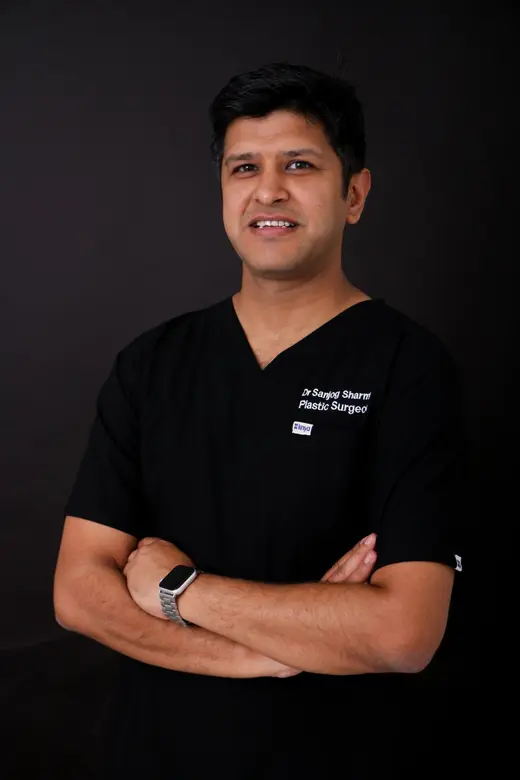
MBBS, MS (General Surgery), DNB (Plastic Surgery) · KMC DLH 2020 0000540 KTK · DHA 24430721
Questions patients ask
Am I a good candidate for rhinoplasty?
You may be a candidate if you're bothered by a hump, a wide or drooping tip, asymmetry or breathing problems from a structural cause — and you're healthy, a non-smoker or willing to stop, at least 18, and realistic about the result. Suitability is confirmed only after an in-person examination.
How much does rhinoplasty cost in Bangalore?
Rhinoplasty cost depends on whether the surgery is cosmetic, functional or both, the approach, whether cartilage grafts are needed, and whether it's a first or revision operation. Dr Sanjog gives a personalised quote after assessing your nose. In Dubai, rhinoplasty is typically in the region of AED 30,000–45,000.
How long is rhinoplasty recovery?
The splint usually comes off after one to two weeks, and most desk-based patients return to work at 10–14 days. Most visible swelling settles in four to six weeks. The tip takes longest, and the final result is judged at about twelve months.
Is rhinoplasty painful?
Surgery is done under general anaesthesia. Afterwards most patients describe pressure, congestion and a mild ache rather than sharp pain, managed with prescribed painkillers. The blocked feeling is usually the most bothersome part and eases as internal swelling settles. Experiences vary between individuals.
Will there be a visible scar?
Closed rhinoplasty uses incisions inside the nostrils, so there is no external scar. Open rhinoplasty adds a small incision across the columella, between the nostrils, which is usually inconspicuous within a few months. Nostril-narrowing leaves fine scars in the natural crease of the nostril.
Can rhinoplasty fix breathing problems?
When breathing difficulty is caused by structure — such as a deviated septum — rhinoplasty can be combined with septal correction to improve airflow in the same operation. Not every breathing problem is structural, so the inside of the nose is examined carefully before surgery is planned.
When will I see the final result?
You'll see the new shape when the splint comes off, but it will look swollen. Around 70–80% of swelling has settled by three months. The final result is conventionally assessed at twelve months, and subtle refinement can continue beyond that, particularly with thicker skin.
When can I wear glasses and exercise again?
Glasses that rest on the bridge are usually avoided for at least six weeks. Light aerobic exercise typically resumes at three to four weeks, gym and weights at about six weeks, and contact sports after three to six months. Your surgeon confirms timings for your procedure.
Related
This page explains the procedure in general terms. It is not a substitute for an in-person consultation. All surgery carries risk, and results vary between individuals.
Start with photos of your profile.
Send front, side and three-quarter photos in good light, and tell Dr Sanjog what bothers you and whether you have any breathing trouble. You'll get an honest view of what rhinoplasty could and couldn't do.