
FUE hair transplant
A hair transplant moves hair you already have, so every plan starts with the one thing you can't make more of — your donor supply. I use FUE, design a hairline that suits your face and your age, and aim for density that still looks natural in ten years.
Quick summary
- Suitable for stable, non-scarring hair loss (male or female pattern) with enough healthy donor hair.
- FUE takes follicles one at a time, leaving tiny dot scars rather than a linear scar, so it suits short hairstyles.
- Transplanted hair usually sheds at 2–4 weeks, starts regrowing at 3–4 months and matures by about 12 months.
- Performed under local anaesthesia; most people return to desk work in 5–7 days.
- Cost depends mainly on graft count — in Bangalore roughly ₹35–₹80 per graft (₹80,000–₹1,80,000); in Dubai about AED 20,000–35,000.
At a glance
- Technique
- FUE
- Anaesthesia
- Local
- Length
- One day, by graft count
- Back to desk work
- 5–7 days
- New growth
- From 3–4 months
- Full result
- About 12 months
- Bangalore
- ₹80,000 – ₹1,80,000
- Dubai
- AED 20,000 – 35,000
Indicative. Your plan and quote are confirmed after consultation; results and recovery vary.
Is it right for you?
A transplant redistributes hair; it does not create new follicles. It tends to work well when:
- Your hair loss is pattern hair loss (androgenetic alopecia) and has been reasonably stable.
- You have enough healthy donor hair at the back and sides of the scalp — assessed at consultation.
- You are in your mid-twenties or older. Earlier on, loss can keep progressing and a young hairline can be outgrown.
- The hair loss is non-scarring. Scarring alopecias and alopecia areata usually need a different approach first.
- You are in good general health, with nothing that impairs healing.
- Your expectations are realistic about density and timing.
If a transplant isn't the right step yet — because the loss is still active or the donor area is limited — I'll say so, and we'll talk about what can protect the hair you have.
How FUE is planned
Individual follicles
Follicles are taken one by one with a micro-punch. There is no linear scar, so it suits short hairstyles. Recovery takes about 7–10 days.
Matched to your donor supply
Early loss (Norwood 2–3) may need 1,000–2,000 grafts; advanced loss (Norwood 5–6) 3,000–5,000 or more. The donor area is never over-harvested to reach a number.
Designed with you
Agreed together and marked on your scalp before anything else — for your face shape and for your age in ten years' time.
Protecting the hair you have
Hair that isn't transplanted can keep thinning, so whether medical treatment makes sense for you is part of the plan.
On the day
You come in the morning. Before anything else we agree the hairline together, marked on your scalp. The donor and recipient areas are numbed with local anaesthesia — you're awake and can rest, watch or listen to something. Grafts are harvested one by one, prepared and placed at the angle and direction of natural hair.
You go home the same day with written aftercare instructions and an aftercare kit, and a review visit is booked. Sleeping semi-upright for the first few nights helps swelling settle.
Recovery, step by step
- Week 1
Mild swelling and redness, easing within 3–5 days. Tiny scabs form around the grafts — don't pick them. Most people return to desk work in 5–7 days. No strenuous activity.
- Weeks 2–4
Transplanted hairs usually shed. This is expected: the follicle stays and prepares for new growth. Avoid direct sun and heavy exercise.
- Months 3–4
New hair starts to appear. It can look fine or slightly wavy at first — part of the normal growth cycle.
- Months 6–9
Density improves visibly for most patients. Growth rate varies between individuals.
- Month 12
Most patients see their full result, which can keep maturing in texture. We review your progress.
Results
Transplanted follicles come from areas that are genetically resistant to balding, so for most patients the result is long-lasting. The hair that wasn't transplanted can keep thinning over time, which is why we plan for the long term — including whether medical treatment to protect existing hair makes sense for you.
How dense the result looks depends on your donor supply, hair calibre and colour, the area covered and how you heal. Results vary; some patients choose a second session for extra density.
Risks & safety
A hair transplant is minor surgery, but it is still surgery. Common, usually temporary effects: swelling of the forehead, scabbing, redness, tightness and temporary numbness of the scalp, and shedding of transplanted hair.
Less common: infection, folliculitis (inflamed follicles), bleeding, shock loss of existing hair near the grafts, lower-than-expected growth, and visible dot scarring in the donor area. Over-harvesting the donor area or a poorly judged hairline can leave results that are hard to correct, which is why planning matters more than graft count.
We go through your personal risks at consultation, including medicines you take and conditions that affect healing.
Cost in Bangalore & Dubai
Roughly ₹35–₹80 per graft. Fees normally include anaesthesia, facility, aftercare kit and a follow-up review — confirm what's included in your quote.
For surgery at Cocoona Clinic or Dubai London Hospital. Your quote is confirmed at consultation; 5% VAT applies in the UAE.
What moves the number
- Graft count — the main driver.
- Donor quality and whether more than one session is planned.
- What's included — aftercare, medicines and reviews.
A personalised quote follows your consultation. Price should never be the only reason to choose a surgeon.
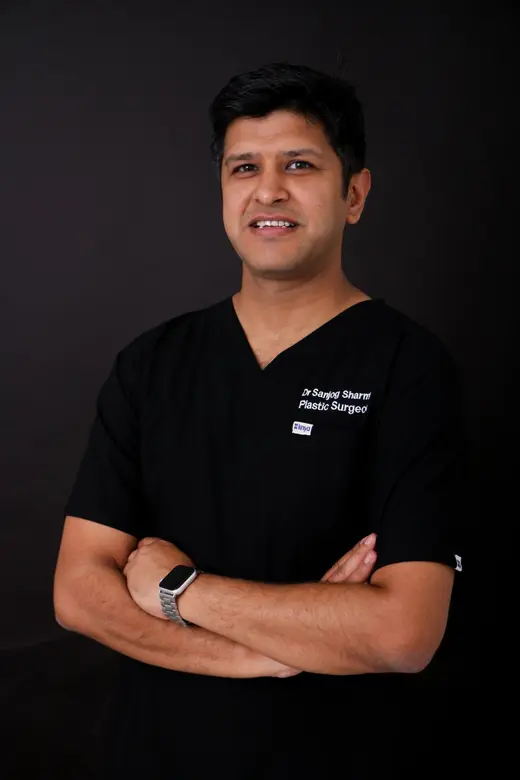
Why patients choose Dr Sanjog
- Plastic surgery training at Maulana Azad Medical College, and as a registrar at AIIMS, New Delhi.
- FUE, with no linear strip scar.
- A hairline designed with you — for your face shape and your age in ten years' time.
- Consultations in Bangalore and Dubai — Aesthetica Veda in Bangalore; Cocoona Clinic in Dubai.
- Honest advice when a transplant isn't the right step yet.
MBBS, MS (General Surgery), DNB (Plastic Surgery) · KMC DLH 2020 0000540 KTK · DHA 24430721
Questions patients ask
Am I a good candidate for a hair transplant?
Usually, if your hair loss is stable and non-scarring (male or female pattern), you have enough healthy donor hair at the back and sides, and your expectations are realistic. Patients in their mid-twenties or older are generally better candidates. Suitability is confirmed only after a scalp examination at consultation.
Do you offer FUT (strip) hair transplant?
No. Dr Sanjog performs FUE hair transplants only. FUE takes follicles one at a time and leaves tiny dot scars rather than a linear strip scar, so it suits people who wear their hair short. Your donor supply and graft estimate are assessed at consultation.
How much does a hair transplant cost?
In Bangalore, an FUE hair transplant with Dr Sanjog typically costs ₹80,000 to ₹1,80,000 — roughly ₹35–₹80 per graft. In Dubai it is in the region of AED 20,000–35,000. The number of grafts you need is the main driver, and a personalised quote follows consultation.
Is a hair transplant painful?
The scalp is numbed with local anaesthesia before any work begins, so most patients feel pressure rather than pain during the procedure. Mild soreness, tightness and swelling are common for a few days afterwards and are usually managed with prescribed painkillers. Discomfort levels vary between individuals.
How long is the recovery?
Most patients return to desk work in 5–7 days, and the small scabs settle within about ten days. Transplanted hairs usually shed at two to four weeks, which is expected. New growth typically starts at three to four months, and the full result is seen at around twelve months.
How long do hair transplant results last?
Transplanted follicles come from areas that are genetically resistant to balding, so results are long-lasting for most patients. Hair that wasn't transplanted can keep thinning over time, so a long-term plan — sometimes including medical treatment — is discussed at consultation. Results vary between individuals.
Can women have a hair transplant?
Some women with pattern hair loss are suitable, provided the cause has been identified and the donor area is stable. Female hair loss has more possible causes, so an examination and sometimes blood tests come first. Whether a transplant can help is decided only after a consultation.
Can I consult from Dubai or abroad?
Yes. You can start with scalp photos on WhatsApp or through the online photo consultation, or see Dr Sanjog in Dubai at Cocoona Clinic. Where your procedure takes place, the timing and your follow-up are planned with you before you book any travel.
Related
This page explains the procedure in general terms. It is not a substitute for an in-person consultation. All surgery carries risk, and results vary between individuals.
Start with photos of your scalp.
Send clear photos of the front, top, crown and back of your head. Dr Sanjog reviews them personally and gives you an honest view on suitability and a graft estimate before you commit to anything.