
Breast augmentation in Bangalore
Breast augmentation isn't about going bigger — it's about proportions that suit your frame and your goals. The most natural results come from implants chosen for your chest width, your own breast tissue and the shape you want, not from a size in a catalogue. Many regrets come from implants that were simply too large.
Quick summary
- Breast augmentation places an implant under the breast tissue or under the chest muscle to increase size and improve shape.
- Silicone gel implants are the most popular for their natural feel; saline implants are an alternative.
- Size is chosen for your frame — most patients choose between about 300 and 500 cc — using sizers at consultation and in theatre.
- Performed under general anaesthesia; most people return to desk work within about a week and avoid lifting and upper-body exercise for 6 weeks.
- Implants are not lifelong devices and may need replacing in future. Surgery starts from ₹1,75,000 in Bangalore and about AED 27,000 in Dubai, in both cases with the implants priced separately.
At a glance
- Implants
- Silicone gel or saline
- Placement
- Under or over the muscle
- Anaesthesia
- General
- Back to desk work
- About 1 week
- Lifting & upper-body exercise
- After 6 weeks
- Settled shape
- 3–6 months
- Bangalore
- From ₹1,75,000 + implants
- Dubai
- From AED 27,000 + implants
Timings are general guidance and are confirmed for you at consultation. Consented patient photographs can be viewed during an in-person consultation.
Is it right for you?
Augmentation may suit you if you'd like larger or fuller breasts, better balance between the two sides, or to restore volume lost after pregnancy or weight loss — and you're in good physical and mental health with realistic expectations.
- Your weight is stable.
- You're not pregnant or breastfeeding — wait several months after breastfeeding ends.
- You understand implants may need replacing at some point in your life.
If the breasts have also dropped, an implant alone may not give the shape you want; a breast lift combined with augmentation is discussed at consultation.
Implants & placement
The most popular choice
Cohesive gel that feels closer to natural breast tissue, with less visible rippling. Modern implants are durable, with a reported rupture rate below 1% a year; gel is designed to stay within the shell or the surrounding capsule.
Salt-water filled
If one ruptures, the body absorbs the saline safely. Usually less expensive, but can feel less natural and ripple more, particularly with little natural breast tissue.
Submuscular
A more natural look when there is little breast tissue, and a lower risk of capsular contracture — with more discomfort and a longer recovery.
Subglandular
A shorter recovery, no movement of the implant when the chest muscle contracts, and chest strength unaffected.
On the day
Breast augmentation is performed under general anaesthesia. The implant is placed through a small incision — most often in the fold beneath the breast — into the pocket planned for you, and the final size is checked with sizers during surgery before the implants are placed.
You go home in a supportive surgical bra with instructions on arm movement, sleeping position and wound care. The exact admission plan is confirmed at consultation.
Recovery, step by step
- Days 1–3
Tightness and soreness across the chest, more so with implants under the muscle. Painkillers, rest and the supportive bra.
- Week 1
Most people return to desk work and light activity. No lifting, pushing or pulling.
- Weeks 2–6
Swelling settles and the implants begin to drop into position. Supportive bra continues; upper-body exercise waits.
- Week 6
Lifting and upper-body exercise resume gradually, as advised.
- Months 3–6
The implants settle and soften into their final shape. Scars keep fading over the following year.
Results
Fuller breasts in proportion with your frame, with a natural feel when the implant and pocket are chosen well. Natural ageing, pregnancy and weight change still affect the breasts over time.
Implants are not lifelong devices. Many last well for years, but some women need implant replacement or revision in future — for rupture, capsular contracture or a change of preference. Results vary between individuals.
Risks & safety
Common and usually temporary: swelling, tightness, bruising and changes in nipple or breast sensation.
Implant-related risks: capsular contracture (scar tissue tightening around the implant), rupture, rippling, implant malposition or asymmetry, and the need for revision surgery in future. Breast-implant-associated anaplastic large cell lymphoma (BIA-ALCL) is rare and linked mainly to textured implants; it is explained at consultation.
General surgical risks: infection, bleeding, visible scarring and reactions to anaesthesia. Your implant choice and personal risks are discussed in detail before surgery.
Cost in Bangalore & Dubai
The implants themselves are priced separately, by brand and type, so the written quote after your assessment sets out both the surgery and the implants.
Plus the implants, as in Bangalore. For surgery at Cocoona Clinic or Dubai London Hospital; your quote is confirmed at consultation, and 5% VAT applies in the UAE.
What moves the number
- Implant type and brand — silicone or saline.
- Placement — under or over the muscle.
- Combined breast lift, if needed.
- Facility and anaesthesia time.
Why patients choose Dr Sanjog
- Sizing for proportion, with sizers — not a catalogue size.
- Clear explanation of implant choices, including long-term maintenance.
- Consented patient photographs can be viewed in person at consultation.
- The surgeon you meet is the surgeon who operates.
- Bangalore or Dubai — Aesthetica Veda in Bangalore; Cocoona Clinic and Dubai London Hospital in Dubai.
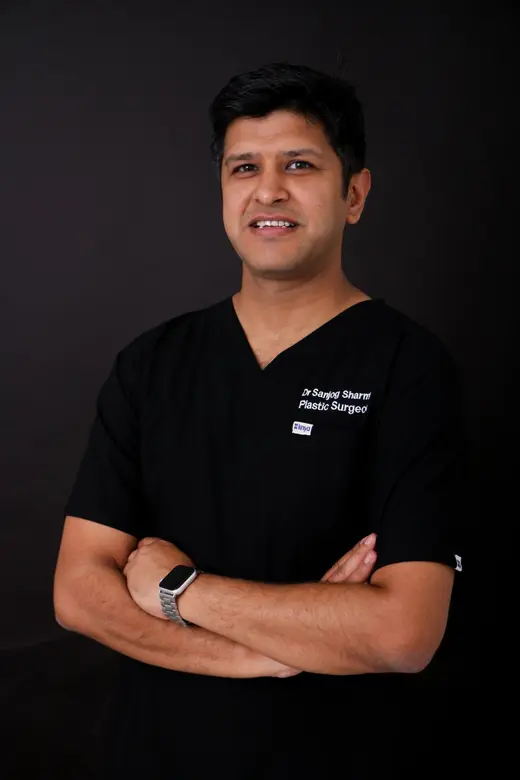
MBBS, MS (General Surgery), DNB (Plastic Surgery) · KMC DLH 2020 0000540 KTK · DHA 24430721
Questions patients ask
How much does breast augmentation cost?
With Dr Sanjog, breast augmentation starts from ₹1,75,000 in Bangalore and about AED 27,000 in Dubai. The implants are priced separately, because the cost depends on the brand and type you choose together. After your assessment you receive a written quote covering both.
What's the difference between breast augmentation and breast implants?
Breast augmentation is the operation to increase the size or improve the shape of the breasts. A breast implant is the medical device most often used to do it. Augmentation can also be done with your own fat in selected patients, which is discussed at consultation.
Do implants feel different to touch?
A well-chosen implant in the right pocket, with enough natural tissue covering it, usually feels close to a natural breast. Silicone generally feels more natural than saline, and implants placed under the muscle are less easy to feel in slim patients. How natural it feels varies between individuals.
When is the right time for breast augmentation?
When you are in good physical and mental health, your weight is stable, and you are not pregnant or breastfeeding — ideally several months after breastfeeding has ended. If you plan more children, pregnancy can change the result, so timing is worth discussing.
Silicone or saline — which is better for me?
Silicone gel feels closer to breast tissue and ripples less, which is why most patients choose it. Saline is absorbed harmlessly if it ruptures and usually costs less, but can feel firmer and ripple more with thin tissue. The choice depends on your body and priorities, and is made at consultation.
How do I choose the right size?
Size is chosen for your chest width, your natural breast tissue and the look you want. Most patients choose between about 300 and 500 cc. Sizers are used at consultation and during surgery. The most natural-looking results come from implants in proportion with your frame.
How long is the recovery?
Most people return to desk work within about a week. Chest tightness is normal for the first days, especially with implants under the muscle. Lifting and upper-body exercise wait for about six weeks, and the implants settle into their final shape over three to six months.
Do breast implants last forever?
No. Implants are not lifelong devices. Many last well for years, but some women need replacement or revision in future — for rupture, capsular contracture or a change of preference. Modern silicone implants have a reported rupture rate below 1% a year. Long-term follow-up is part of the plan.
Can I breastfeed after breast augmentation?
Many women breastfeed successfully after augmentation, particularly when the implant is placed through an incision in the breast fold. It cannot be promised for everyone, because breast anatomy varies. If breastfeeding in future matters to you, say so at consultation so the approach can take it into account.
Related
This page explains the procedure in general terms. It is not a substitute for an in-person consultation. All surgery carries risk, and results vary between individuals.
Plan your breast augmentation.
Tell Dr Sanjog what you'd like to change and, if you're comfortable, share photos. At consultation you'll try sizers and go through implant choices, risks and cost before deciding anything.