
Brazilian Butt Lift in India: Patient Selection, Safety, and What to Realistically Expect
A Dubai and Bengaluru surgeon explains BBL patient selection, the fat transfer technique, safety, and realistic results for Indian and NRI patients.
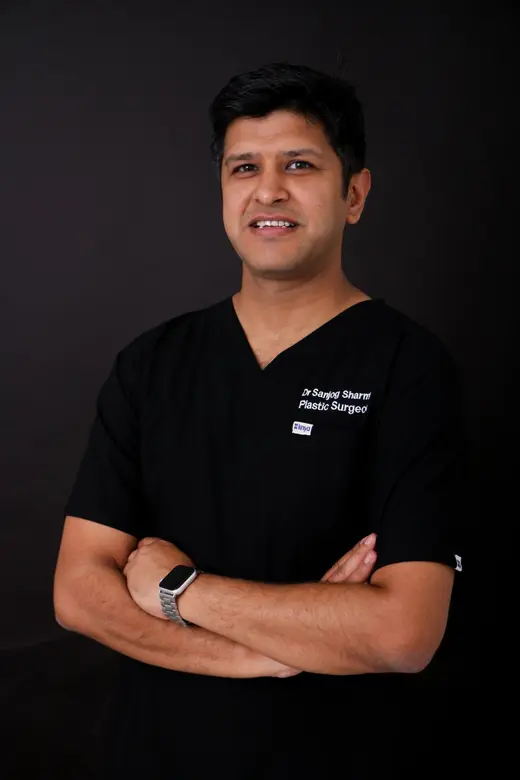
Published 23 June 2026 · 6 min read
Key points
- A BBL transfers the patient's own fat, harvested by liposuction, to reshape the buttocks.
- Safety depends on injecting fat above the muscle, never into it.
- Candidacy requires adequate donor fat and realistic expectations.
- A portion of transferred fat is reabsorbed, so final volume settles over months.
- Recovery includes limiting direct pressure on the buttocks in the early weeks.
In this article
- Brazilian Butt Lift: What the Procedure Actually Involves — and Where Safety Depends on the Surgeon
- How the BBL Technique Works
- Who Is a Good Candidate
- The Safety Question — What Every Patient Must Understand
- Fat Graft Survival: Setting Realistic Expectations
- Recovery: The First Eight Weeks
- NRI Patients Returning to Bengaluru for BBL
Brazilian Butt Lift: What the Procedure Actually Involves — and Where Safety Depends on the Surgeon
The Brazilian Butt Lift has become one of the most requested body contouring procedures globally. It has also, at various points, been the most scrutinised — and for legitimate reasons. The technique involves harvesting fat from donor areas via liposuction, processing it, and re-injecting it into the buttocks to enhance volume and shape. Done correctly by a trained surgeon following established safety protocols, it is a transformative procedure. Done incorrectly, it carries serious risk.
Last medically reviewed by Dr. Sanjog Sharma, MBBS MS DNB — 2026-06-23
This article is aimed at patients in India — including NRI patients returning from the UAE, UK, or elsewhere — who are considering this procedure and want a clear-eyed clinical picture before booking a consultation.
How the BBL Technique Works
The Brazilian Butt Lift is not a single operation so much as a sequenced set of technical steps, each of which affects the outcome.
Step 1: Liposuction of donor sites
Fat is harvested using liposuction from areas the patient wants reduced — typically the abdomen, flanks, lower back, and inner thighs. This component is not incidental; the liposuction phase is where a significant portion of the contouring result comes from. Thinning the waist-to-hip ratio by removing fat from the flanks and lower back can be as visually impactful as the augmentation itself.
The fat is harvested using low-vacuum or power-assisted techniques to preserve cell viability. Aggressive mechanical trauma to the harvested tissue reduces graft survival.
Step 2: Fat processing
Harvested fat is processed — centrifuged or filtered — to separate viable fat cells from oil, blood, and tumescent fluid. Only the purified fat fraction is re-injected. Some surgeons use closed-loop processing systems that minimise exposure to air and contaminants, which is the protocol I follow at Cocoona Centre for Aesthetic Transformation in Dubai.
Step 3: Fat injection
This is the step where safety risk is concentrated. Fat must be injected exclusively into the subcutaneous layer — the fat layer beneath the skin. Injection into or beneath the gluteal muscle carries risk of inadvertent cannulation of the gluteal veins, which can cause fat embolism. This is the mechanism behind the historically high BBL mortality rate and remains the single most important technical variable.
Current guidelines from international plastic surgery societies mandate subcutaneous-only injection, performed with blunt-tipped cannulas under careful anatomical awareness.
Who Is a Good Candidate
Not every patient who wants a BBL is a suitable surgical candidate. The assessment I conduct at my Bengaluru clinic at Aesthetica Veda in Whitefield mirrors exactly what I do at Dubai London Hospital in Dubai — a structured evaluation of four key domains.
| Assessment Domain | What I Am Looking For | Factors That Complicate Candidacy |
|---|---|---|
| Donor fat availability | Adequate harvestable volume (typically BMI at least 23) | Very lean patients, recent rapid weight loss |
| Skin quality | Good elasticity in buttock region | Significant skin laxity from weight loss or ageing |
| General health | ASA Class I or II, non-smoker | Active smoker, uncontrolled diabetes, BMI > 35 |
| Expectations | Realistic understanding of volume limits | Expecting implant-level augmentation from fat transfer |
| Anatomy | Appropriate gluteal soft tissue depth | Very muscular buttocks with minimal subcutaneous fat |
Patients who are very lean — a BMI below 22 — frequently do not have sufficient donor fat for meaningful augmentation. In these cases, I have an honest conversation about whether the procedure can achieve what the patient wants. Overpromising on volume is a disservice.
South Asian patients often have a favourable fat distribution for BBL — with adequate abdominal and flank fat that can be harvested — but can have denser, more fibrous fat in some areas, which affects how the liposuction component is performed and which cannula selection I use.
The Safety Question — What Every Patient Must Understand
In my practice in Dubai, where I operate across a range of nationalities — South Asian, Arab, African, and Western expatriate patients — BBL is among the procedures patients research most extensively before their consultation. And the question I am asked without exception is: Is it safe?
The honest answer is: it depends on the surgical approach.
The International Society of Aesthetic Plastic Surgery (ISAPS) and the American Society of Plastic Surgeons have both issued formal safety advisories on BBL technique. The consensus is clear — the risk of fatal fat embolism is real but largely preventable through strict adherence to subcutaneous injection technique, verified with ultrasound or anatomical landmarks, and the use of appropriate cannula sizing.
Patients should ask their surgeon directly:
- What layer do you inject fat into?
- What cannula size and type do you use for injection?
- How do you confirm you remain in the subcutaneous plane?
- What is your facility's emergency protocol?
These are not aggressive questions. They are appropriate questions. A surgeon who is trained in this procedure will answer them directly and specifically.
Fat Graft Survival: Setting Realistic Expectations
Not all of the transferred fat survives. This is not a complication — it is a biological reality of fat grafting. Approximately 60–80% of transferred fat achieves durable vascularisation and becomes permanent. The remainder is reabsorbed by the body over the first three to six months.
This means that some degree of volume reduction is expected and normal between the immediate post-operative result and the three-month assessment. Surgeons account for this by slightly overcorrecting — transferring a calculated volume above the target — knowing that a proportion will be reabsorbed.
Factors that improve graft survival include:
- Atraumatic harvesting and processing
- Injecting small aliquots across multiple planes of the subcutaneous tissue (multi-plane technique)
- Avoiding direct pressure on the buttocks for six to eight weeks post-operatively
- Maintaining stable weight in the months following surgery
Significant weight loss after a BBL reduces the volume of the grafted fat, since transferred fat cells behave like normal fat cells — they shrink with caloric deficit. Conversely, weight gain can increase volume. Patients who are actively losing weight — including those on GLP-1 medications — should reach and stabilise at their target weight before BBL surgery.
Recovery: The First Eight Weeks
The recovery from BBL surgery is distinct from other body contouring procedures in one important way — the positional restrictions.
| Timeframe | Key Restrictions | What to Expect |
|---|---|---|
| Days 1–3 | No sitting or lying on buttocks; sleep prone or on side | Significant swelling, compression garment worn continuously |
| Week 1–2 | Minimal sitting using BBL cushion only; avoid pressure | Bruising peaks then begins to fade; drains removed if used |
| Weeks 3–6 | Graduated return to sitting with cushion; no exercise | Swelling reduces progressively; early results emerging |
| Weeks 6–8 | Normal sitting resumed; light activity permitted | Most swelling resolved; final contour beginning to appear |
| 3–6 months | Full activity resumed | Final graft survival assessed; true long-term result visible |
NRI Patients Returning to Bengaluru for BBL
A significant portion of patients who consult me at my Whitefield clinic are Indian expats — from the UAE, UK, or Australia — who have researched this surgery in Dubai and are scheduling it during a visit home to Bengaluru. For these patients, the value proposition is straightforward: they are seeing the same surgeon, following the same protocols, in a well-equipped surgical facility, at a fraction of the cost they would pay in the Gulf.
The practical planning consideration for these patients is time. The combination of liposuction and fat transfer means a recovery period of at least six weeks before flying is advisable. Patients who plan a two-week trip home and expect to fly back to Dubai or London with a new result are not planning realistically. Surgery visits should be planned with a minimum of eight weeks in Bengaluru.
Questions patients ask
Is Brazilian Butt Lift surgery safe?
BBL has historically carried the highest mortality risk of any elective cosmetic procedure, primarily due to fat embolism. However, when performed by a trained plastic surgeon following current safety protocols — including injecting fat only into the subcutaneous layer and using real-time imaging guidance — the risk is significantly reduced. Patient selection and surgical technique are the most critical safety variables.
Am I a good candidate for a Brazilian Butt Lift?
Ideal candidates have sufficient donor fat available for harvesting (typically a BMI of 23 or above), good skin elasticity, realistic expectations, and are non-smokers in good general health. Patients who are very lean or have lost significant weight recently may not have enough donor fat for meaningful augmentation.
How long do BBL results last?
Approximately 60–80% of transferred fat survives long-term once the graft has vascularised, typically assessed at three to six months. The remaining volume is permanent, though it will change with significant weight fluctuations. Maintaining a stable weight after surgery preserves results best.
Can I sit after a Brazilian Butt Lift?
Patients are advised to avoid direct pressure on the buttocks for approximately six to eight weeks post-operatively. A BBL pillow or cushion is used to transfer pressure to the thighs when seated. This is not optional — early pressure on the grafted fat impairs blood supply and reduces graft survival.
How much does a Brazilian Butt Lift cost in Bengaluru?
Cost varies depending on the volume of fat transferred, anaesthetic fees, facility charges, and the complexity of the liposuction component. A detailed quote requires an in-person assessment. Patients who have consulted for this procedure in Dubai often find that comparable surgical standards in Bengaluru represent significant cost savings.
What is the difference between BBL and buttock implants?
A BBL uses your own harvested fat, giving a more natural feel and allowing simultaneous contouring of donor areas. Implants are silicone-based and are reserved for patients who lack sufficient donor fat. Fat transfer has a lower long-term complication profile than implants, but requires adequate fat reserves in the patient.
References
- Mofid MM, Teitelbaum S, Suissa D, Ramirez-Montañana A, Astarita DC, Mendieta C, et al. Report on Mortality from Gluteal Fat Grafting: Recommendations from the ASERF Task Force. Aesthet Surg J. 2017;37(7):796–806. doi.org/10.1093/asj/sjx004
- Cansancao AL, Condé-Green A, Gouvea Rosique R, Junqueira Rosique M, Cervantes A. "Brazilian Butt Lift" Performed by Board-Certified Brazilian Plastic Surgeons: Reports of an Expert Opinion Survey. Plast Reconstr Surg. 2019;144(3):601–609. doi.org/10.1097/PRS.0000000000006020
- Oranges CM, Tremp M, di Summa PG, Haug M, Kalbermatten DF, Harder Y, et al. Gluteal Augmentation Techniques: A Comprehensive Literature Review. Aesthet Surg J. 2017;37(5):560–569. doi.org/10.1093/asj/sjw240
- Del Vecchio D, Kenkel JM. Practice Advisory on Gluteal Fat Grafting. Aesthet Surg J. 2022;42(9):1019–1029. doi.org/10.1093/asj/sjac082
- Rosique RG, Rosique MJF, De Moraes CG. Gluteoplasty with autologous fat tissue: experience with 106 consecutive cases. Plast Reconstr Surg. 2015;135(5):1381–1389. doi.org/10.1097/PRS.0000000000001167
- Kaoutzanis C, Gupta V, Winocour J, Layliev J, Ramirez R, Grotting JC, et al. Cosmetic Liposuction: Preoperative Risk Factors, Major Complication Rates, and Safety of Combined Procedures. Aesthet Surg J. 2017;37(6):680–694. doi.org/10.1093/asj/sjw243
MBBS, MS (General Surgery), DNB (Plastic Surgery) · KMC DLH 2020 0000540 KTK · DHA 24430721
This article is general information for patients and does not replace a consultation. Costs mentioned were indicative when it was written — current Bangalore and Dubai ranges are on each procedure page. All surgery carries risk, and results vary between individuals.
A question about your own case? Send it with photos — Dr Sanjog replies personally.
WhatsApp